
HealthyMindEd review highlights critical need for institutions to support student well-being in digital settings
by Anna Muro i Rodríguez, Universitat Autònoma de Barcelona, Spain.
The rapid expansion of digital education following COVID-19 led higher education institutions worldwide to shift from face-to-face to online, blended, or hybrid formats. Even after the crisis, well-being challenges persist, indicating that digital learning is no longer a temporary solution but a permanent part of the educational ecosystem that requires thoughtful, long-term support. This transformation has reshaped teaching practices and working conditions for both students and staff, raising growing concerns about the academic community’s well-being.
Research during the pandemic highlighted negative well-being outcomes - including stress, anxiety, depression, insomnia, and burnout - often linked to hyperconnectivity and reduced social interaction. However, far less is known about well-being in the post-pandemic period, as institutions moved from emergency remote teaching to more structured digital models. To address this gap, the HealthyMindEd project conducted a scoping review synthesising current evidence on student and teaching staff well-being in digital higher education environments.
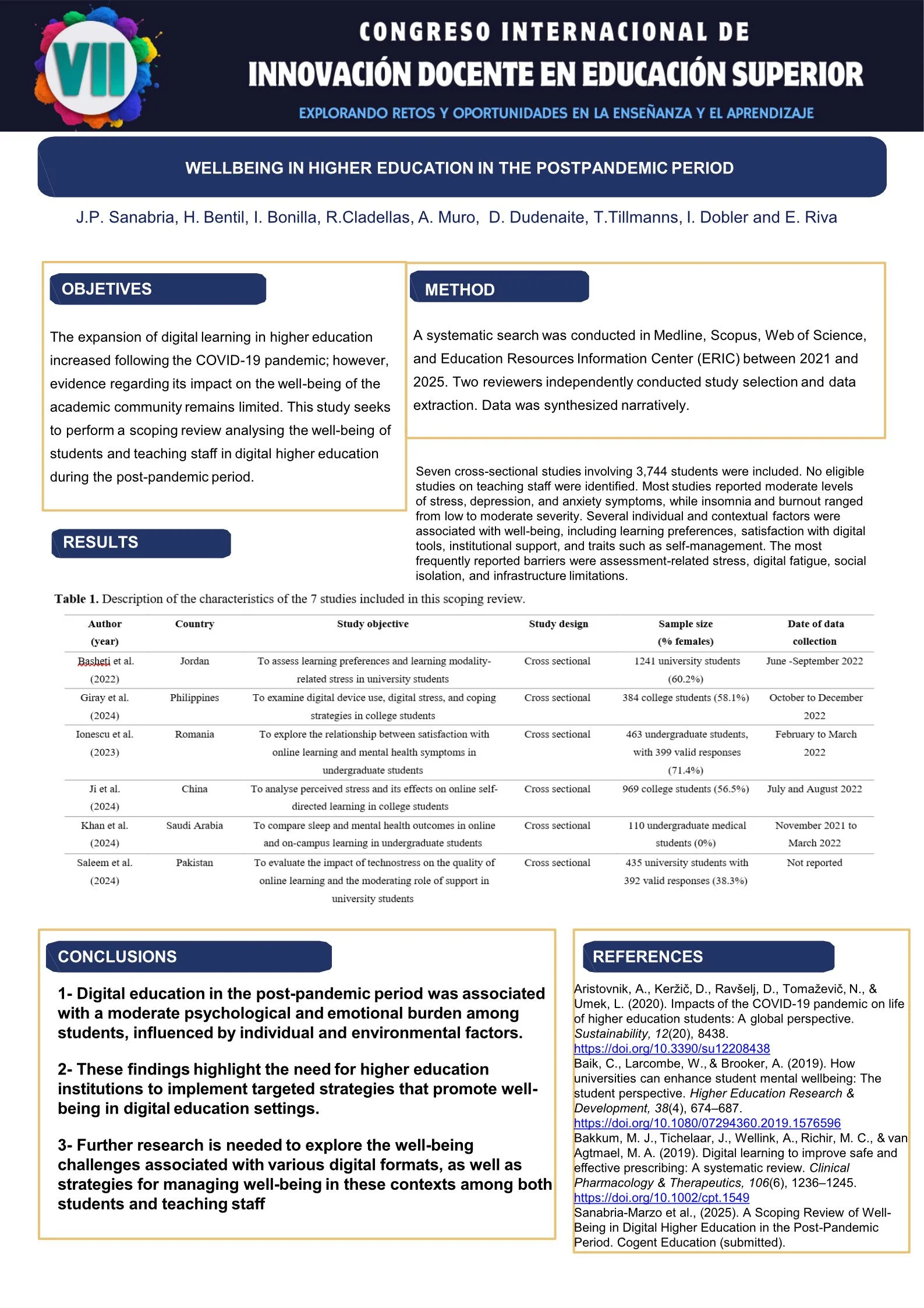
This scoping review followed the "Preferred Reporting Items for Systematic Reviews and Meta-Analysis Extension for Scoping Reviews (PRISMA-ScR)" guidelines. Systematic searches were carried out in four major databases: Medline, Scopus, Web of Science, and ERIC, covering studies published from January 2021 to February 2025. The search strategy employed the PEO (Population–Exposure–Outcome) approach, targeting higher education students and teaching staff (Population), exposed to various forms of digital education (Exposure), and reporting well-being outcomes (Outcome). Crucially, only post-pandemic studies were included - those collecting data after the most restrictive COVID-19 phase and reflecting structured digital/hybrid models.
Two reviewers independently screened studies, extracted data using a standardised template, and resolved discrepancies by consensus. The extracted information covered publication details, study design, sample characteristics, educational context, digital tools used, well-being outcomes, challenges, and recommendations. A narrative synthesis was used to describe the findings of the included studies.
The systematic search identified 5,493 studies, culminating in the inclusion of only seven cross-sectional studies that met the eligibility criteria. The review successfully synthesised findings from seven cross-sectional studies, which collectively involved 3,744 students. Notably, no eligible studies on the well-being of teaching staff were identified. All included studies focused on students, predominantly undergraduates, and were based on data collected between 2021 and 2022.
The studies consistently reported well-being outcomes - including stress, depression, anxiety, insomnia, burnout, technostress, and digital stress—as generally low to moderate. For instance, students in hybrid settings reported moderate levels of depression, anxiety, and insomnia, and moderate technostress was found in synchronous online settings. In blended learning environments, moderate stress and burnout were reported, with digital teaching identified as a significant predictor of academic burnout in one study. However, one study comparing synchronous online versus on-campus learning found lower anxiety, stress, and sleepiness in the online format. Well-being was associated with individual and contextual factors. Online satisfaction was associated with lower depression, anxiety, and insomnia. Furthermore, institutional support—both from instructors and the university level - acted as a significant buffer, reducing the negative impact of technostress on perceived learning quality. Individual traits, such as strong self-management skills, were found to buffer the negative effect of phone dependence on self-directed learning.
Results also showed that persistent challenges in digital environments included assessment-related stress (e.g., tight exam times), digital fatigue and techno-overload from prolonged screen time, social isolation, notification overload, limited learning space, and connectivity issues. Extensive digital exposure, especially heavy device use, correlated positively with higher digital stress. The ability of students to access Virtual Learning Environments (VLEs) “anytime/anywhere” was described as a “double-edged sword”, promoting overexposure and blurring boundaries. Therefore, digital education in the post-pandemic period is associated with a moderate psychological and emotional burden among higher education students. This moderate burden suggests a stabilisation compared to the acute stressors observed during the pandemic. The level of well-being is heavily influenced by individual factors, such as self-management skills and learning preferences, and contextual factors, particularly institutional and instructional support.
The review highlights the critical need for institutions to adopt targeted strategies to support student mental health and well-being in digital settings. Recommendations include strengthening support systems, providing self-management training, adopting structured digital pedagogies, and potentially introducing policies (like scheduled downtime) to mitigate the effects of constant digital connectivity. A major limitation and future research imperative is the profound evidence gap regarding the experiences and needs of teaching staff and postgraduate populations in digital learning environments that have not yet been analysed. Future work should also explore physical health outcomes, consider individuals’ total exposure time to digital environments (e.g., screen time effects), and utilise mixed-methods and longitudinal studies across diverse contexts to fully capture the evolving relationship between digital learning and well-being.